assembly theory
measuring selection and causal depth in molecules, spectra, and planetary atmospheres
Complexity measures are easy to invent and hard to trust. Almost all of them are defined on a representation — a string, a compressed file, a graph descriptor — so the number you get out depends on how you chose to write the object down. Assembly theory takes a different route. It asks how many steps are needed to build an object from its elementary parts, allowing anything already made along the way to be reused, and it insists that this number be measurable in a laboratory rather than merely computable from a model.
Two quantities do the work. The assembly index of an object is the minimum number of causal joins required to construct it from its units, and its copy number is how many indistinguishable instances of it are present in a sample. Together they define the assembly of an ensemble,
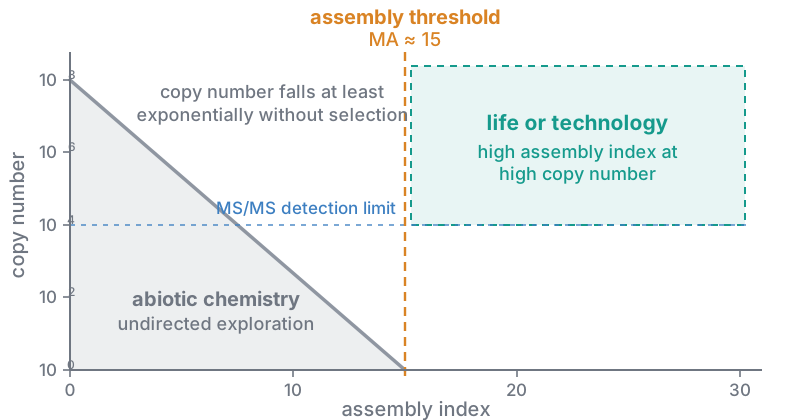
\[A = \sum_{i,\; n_i > 1} e^{a_i} \frac{n_i}{N_T},\]where the sum runs over distinguishable object types and \(N_T\) is the total number of objects observed. The index measures causal depth; the copy number measures whether some mechanism keeps producing that depth. Neither alone is diagnostic. Their conjunction is, because the number of possible objects grows at least exponentially with assembly index, so an undirected process is exponentially unlikely to make the same deep object many times over.
My own work is on the part of this that has to actually run: the algorithms that compute the index, the software that makes it usable outside the group that invented it, the curated chemical spaces to test it against, and the spectroscopic pipelines that measure it on samples rather than on structures.
What the index measures, and why it can be measured at all
An assembly space is a set of objects together with a rule saying which pairs may be joined into which products. Units are the objects that are not the product of any join, and every object in the space must be reachable from the units in finitely many steps. For molecules the objects are graphs with coloured vertices (atoms) and coloured edges (bonds), a join identifies a non-trivial subset of same-coloured vertices between two fragments, and the units come out as single bonds. Nothing about that definition refers to how the molecule was actually made.
That is the point. Environmental and historical constraints — which catalyst, which cell, which geochemical setting — are usually unknown and always context-dependent, but the bonds in a molecule are there in the object itself. Because the elementary steps are physical, the index is accessible to instruments: tandem mass spectrometry, NMR, and infrared spectroscopy all give handles on it, and they agree. This is what separates assembly theory from complexity measures that only exist on paper. It also separates it from machine-learning approaches to life detection, which have to be trained on known biology and inherit its assumptions (Slocombe & Walker, 2024).
It is a genuinely different quantity from the chemical complexity scores it is often compared against. Böttcher and Bertz indices count structural features — branching, rings, connectivity patterns — whereas the assembly index counts the minimum contingent information required to put the object together. Reaction grammars describe mechanism on kinetic timescales; the assembly index accumulates causation over evolutionary ones. Entropy captures the distribution of microstates but says nothing about the pathway. And unlike compression-based measures, it does not depend on how the data were encoded or labelled.
Spaces defined this way nest, and the nesting is what carries the notion of selection. The assembly universe contains everything any joining operation could produce, including structures that violate valence; the assembly possible is the subset reachable by physically valid joins; and an assembly contingent is a single resource-bound, time-bound trajectory through it — a history. What an instrument recovers from a sample is an assembly observed, one contingent space among the many that could have been realised. How strongly a system prefers particular routes through this structure is parameterised directly: unbiased exploration sits at α = 1, and smaller values mean sharper preference for specific construction paths.
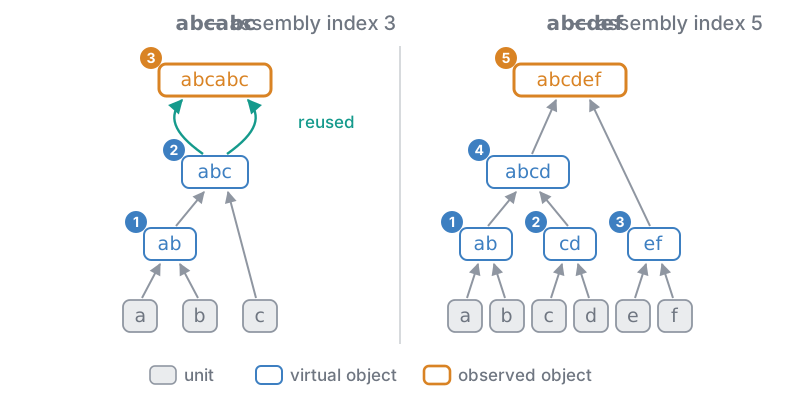
abc can be reused once it exists, abcabc takes three joins; abcdef repeats nothing and takes five. The intermediates on the shortest path are causally necessary but need not be independently observable. The threshold
The empirical anchor for all of this is a threshold. Marshall and colleagues computed assembly indices across 2.5 million organic compounds and measured them by tandem mass spectrometry on biological, abiotic, taphonomic, and blinded samples. Above a molecular assembly index (MA) of about 15 — at copy numbers above the tandem MS detection threshold of roughly 10⁴ — such molecules turned up only in samples of biological origin. No false positives.
That single number is what makes assembly theory operational for astrobiology. It provides a life-detection test that does not presuppose which chemistry life is made of, only that whatever made the molecule had to select a deep pathway and then repeat it. The molecules do not have to be identified, and the sample does not have to resemble anything on Earth.
Computing it is the bottleneck
Calculating an assembly index is NP-hard, and this is the practical obstacle to using the theory on anything large. Early implementations were bespoke: an initial calculator in Go, later work in C++, more recently in Rust. They were scattered across papers, mostly limited to covalently bonded molecules, and each imposed a substantial barrier to entry.
AssemblyCPP-v5, the C++ calculator that does the heavy lifting for us, gets its speed from two things. During the enumeration of duplicatable subgraphs, fragments are stored as Boolean edge-lists against the parent graph and hashed, so both fragments and multi-piece assembly states can be memoised — dynamic programming over previously seen structures. On top of that, the search tree is pruned by a branch-and-bound heuristic: searching fragments in decreasing order of size lets you bound the achievable index using an addition chain conditional on the largest fragment that can be taken, and the current version tightens this by accounting for the second-largest fragment as well, applying the bound both before and after fragmentation.
The formal side matters too, since much of the confusion around assembly theory has come from imprecise definitions. Work with Gage Siebert and colleagues sets out assembly spaces rigorously and develops fast methods for approximating assembly indices where exact computation is out of reach (Siebert et al., 2026) — which, given NP-hardness, is the regime most interesting applications live in.
AssemblyTheoryTools
AssemblyTheoryTools (ATT) is the software layer over all of this (Slocombe et al., 2026). It is a Python package that wraps the fast C++ and Rust calculators, handles their input and output, and exposes assembly theory through an interface that assumes Python and nothing more specialised.
The scope is deliberately wider than chemistry. Molecules come in as SMILES, InChI, mol files, RDKit objects, or anything ASE or RDKit can read; strings come in directly, directed or undirected; and anything else that can be encoded as a coloured graph comes in through NetworkX. Every calculation returns three things — the index, the list of virtual objects on the shortest path, and the directed graph showing how they combined — which is what makes downstream analysis possible rather than just index lookup. Joint assembly spaces let you ask what a set of objects costs to co-assemble, typically far less than the sum of the individual indices, since intermediates are shared.
Beyond calculation, the package explores assembly space: reconstructing pathways, enumerating the neighbourhood of structures reachable by a single join, and generating new objects from the assembly pool of an input molecule under valence constraints. This is the mode used for drug discovery, where deconstructing known actives into pathways and recombining fragments along them yields candidates that keep the parent’s efficacy with different structure. Through ASE it also hooks into electronic-structure calculations, so properties can be attached to objects along a pathway. Calculations parallelise across cores and onto clusters; the package installs from pip or conda and runs on Linux, Windows, and macOS.
Measuring it on spectra instead of structures
Computing the index needs the structure. Measuring it does not, and that is the more useful direction for anything you might find on another planet.
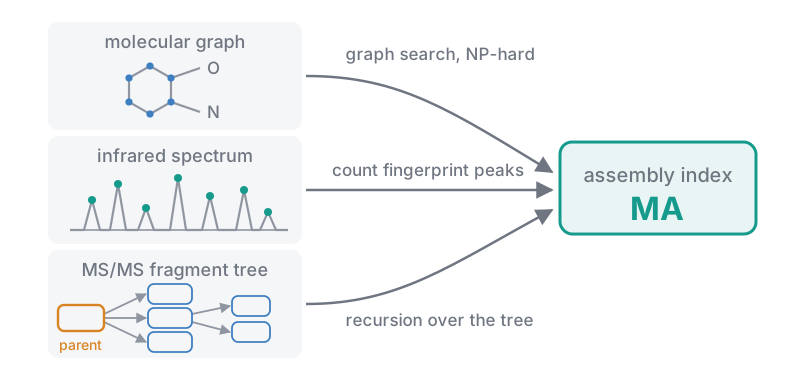
Infrared. The number of peaks in the fingerprint region tracks the assembly index linearly, a relationship rooted in the molecule’s quantum state. Validating this against the Chemotion IR repository means smoothing real spectra before peak-finding — noise inflates the count badly — then fitting predicted against graph-computed indices across the database.
Tandem mass spectrometry. Fragmentation reveals a molecule’s constructive hierarchy directly, so an MS/MS tree can be read backwards as an assembly pathway. Without fragmentation data the best you can do is a mass approximation, MA ≈ 0.047 × MW − 0.4, fitted across more than 16 million PubChem molecules; it degrades for heavy atoms like bromine and iodine, for molecules with repeating units, and for exactly the heavy molecules that make good biosignatures, since the bounds on MA diverge with mass. The recursive algorithm does better by walking the fragment tree from the parent ion down, matching daughter masses to plausible join operations at each level and recursing. A branch terminates either on a single element, contributing nothing, or on an ion with no observed daughters, where the mass approximation fills in. The reported index is the shortest constructive route found through the whole tree. On a 297 Da phosphonate ester with a graph-computed index of 14, the recursive estimate returns about 13, from spectra alone.
Beyond molecules
The formalism generalises, but not for free. The molecular case works because chemical bonds are simultaneously the physical constraints that record causation and the things instruments can see. Carry the same bond-by-bond construction over to a long peptide or a genome and it stops being informative — there you want units and joins that sit where the constraints actually are, at peptide bonds or higher-level motifs or modular subunits.
The real difficulty is not encoding an object as a graph, which is usually easy. It is finding domains where the symmetries and repeated motifs an assembly calculator detects correspond to something functionally meaningful and measurable, rather than to an artefact of how the data were labelled or coarse-grained. Validated substrates so far are molecules, planetary atmospheres, and periodic solid-state materials.
Atmospheres are where I have been most involved in pushing past the molecular case. An exoplanet atmosphere is observed spectroscopically and never resolved into individual molecules, which is precisely the regime where a measurable-without-identification complexity scale is worth having — you can ask whether the mixture shows evidence of chemical selection without knowing what is in it (Janin et al., 2025). The mission-relevant version of that argument, aimed at the Habitable Worlds Observatory, is set out in (Walker et al., 2026).
Chemical space to test against
None of the above is testable without well-curated chemistry to run it on. CBR-db is a curated biochemical reaction database built for this kind of analysis (Slocombe et al., 2026): over 18,000 compounds with associated KEGG reactions, cleaned so that every entry parses into a chemical graph. Surveying assembly indices across it shows the shape of biochemical space — a lower bound on the index that grows logarithmically with molecular weight against an upper bound that grows linearly, with the gap between them opening up as molecules get large enough to contain recursive substructure.
Related threads
The same interest in what selection leaves behind in chemistry runs through work on the emergence of molecular chirality from metabolic network structure (Malloy et al., 2025), and on the deep-time stability of proteome elemental composition across cellular and viral life (Benites et al., 2026).
Software
AssemblyTheoryTools and CBR-db are open source and actively maintained at ELIFE-ASU/assemblytheorytools and ELIFE-ASU/CBRdb, with tutorials covering installation, assembly-index computation, assembly-space construction, and the spectroscopic pipelines described above.
References
2026
- Assembly Spaces: Formal Definitions and Fast Methods for Approximating Assembly IndicesarXiv preprint arXiv:2606.15499, 2026
- Quantifying Complexity and Recursivity in Chemistry and Beyond: AssemblyTheoryToolsNature Protocols, 2026Under consideration
- Searching for Life-As-We-Don’t-Know-It: Mission-relevant Application of Assembly Theory for Exoplanet Life DetectionarXiv preprint arXiv:2603.11086, 2026Habitable Worlds Observatory RFI white paper
-
- Deep-time Consistency in Proteome Elemental Composition Across Cellular and Viral LifearXiv preprint arXiv:2605.19333, 2026
2025
- Searching for Life as We Don’t Know It: Detecting Signatures of Chemical Selection in Exoplanet AtmospheresIn 246th Meeting of the American Astronomical Society, 2025
- The Emergence of Chirality from MetabolismNature Communications, 2025Accepted; preprint available as arXiv:2505.01056