proton transfer in DNA
nuclear quantum effects, tautomerisation, and the origin of spontaneous point mutations
The bases of DNA are held together by hydrogen bonds, and a hydrogen bond is really a proton sitting in a double-well potential. In 1963 Löwdin proposed that such a proton could hop to the opposite base, converting a Watson–Crick pair into a rare tautomer that mispairs during replication — a purely quantum-mechanical route to a spontaneous point mutation. The idea was attractive but largely dismissed: a warm, wet, noisy cell is a hostile place for delicate quantum behaviour, and the tautomer was assumed to collapse long before a polymerase could ever read it.
My work asks whether that dismissal holds up once you treat the problem properly — with an accurate electronic structure description of the base pair, quantum dynamics for the proton, an explicit model of the dissipative cellular environment, and the enzymes of the replisome actually present.
Mapping the energy landscape
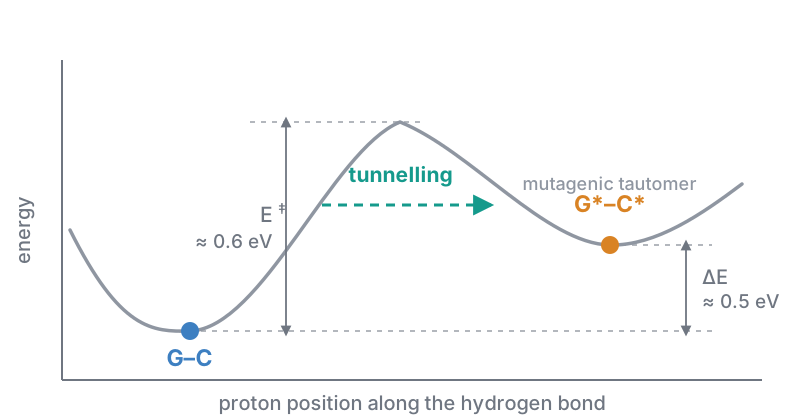
The starting point was a careful map of the reaction surface connecting the canonical amino-keto pairs to their imino-enol tautomers, built with density functional theory and machine-learning nudged elastic band methods (Slocombe et al., 2021). A–T and G–C behave very differently. The reverse barrier for A–T is so small that the tautomer simply falls back before it can do anything biologically meaningful, whereas the thermal population of G–C is large enough to be worth taking seriously — and, in principle, large enough to propagate through the replisome.
Tunnelling dominates, and decoherence does not kill it
Barriers alone do not settle the question; the proton’s dynamics do. Coupling the base-pair potential to an open quantum systems master equation — the proton interacting with a decoherent, dissipative environment — shows that the quantum tunnelling contribution to proton transfer is several orders of magnitude larger than classical over-the-barrier hopping (Slocombe et al., 2022). The consequence is that the canonical and tautomeric forms interconvert on timescales far shorter than biological ones, so the base pair reaches thermal equilibrium essentially instantly, with a tautomeric occupation probability of 1.73 × 10⁻⁴. That is orders of magnitude above the observed rate of spontaneous point mutations, which turns the interesting question into a different one: not whether tautomers form, but whether any of them survive long enough to be read by a polymerase.
Strand separation traps the tautomer
Equilibrium in a closed duplex is only half the story: mutations are fixed when the strands come apart at the replication fork. The double proton transfer turns out to follow a sequential, step-like mechanism whose barrier rises quasi-linearly as the strands separate (Slocombe et al., 2022). Unzipping therefore does two opposing things at once — it slows the formation of new tautomers while sharply increasing the stability of any that already exist, effectively trapping the population that was there when the fork arrived.
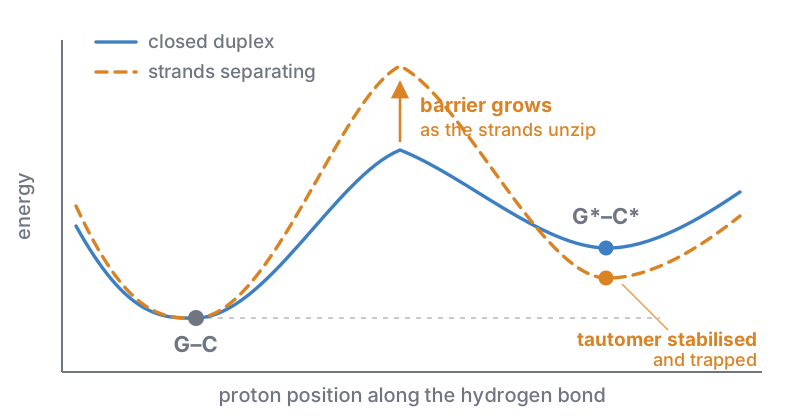
Molecular dynamics puts a clock on this. Across 210 simulations and 1,442 separation events the strands part at roughly 1.2 Å ps⁻¹, meaning a tautomer needs to survive only about 1.7 ps to be carried through — two orders of magnitude less demanding than the ~100 ps that earlier work had assumed.
The A–T pair deserves a second look for the same reason. Although A–T is unstable in the closed duplex, its stability increases as the strands unzip and the hydrogen bonds stretch, which reopens a proton-transfer route to point mutations in A–T that the equilibrium picture had ruled out (King et al., 2023).
The enzymes change the answer
Treating DNA in water is a convenient idealisation; replication happens inside proteins. QM/MM simulations of the bacterial PcrA helicase show how much that matters (Winokan et al., 2023). The local protein environment raises the forward barrier from 0.60 ± 0.04 eV in aqueous DNA to 1.24 ± 0.07 eV in the helicase site, and pushes the reaction asymmetry from 0.54 ± 0.08 eV to 1.68 ± 0.10 eV — collapsing the tautomeric equilibrium constant by roughly eighteen orders of magnitude. One residue does much of the work: asparagine N624 appears to serve a secondary function of suppressing spontaneous mutation. The same study is a caution about methodology, since ensemble-averaging washes out structure in the reaction profile that matters for the tunnelling regime.
At the other end of the replisome, the polymerase active site pushes in the opposite direction. Modelling guanine–thymine wobble misincorporation with QM/MM coupled to an open quantum systems master equation reveals a short-lived “tunnelling-ready” configuration along the wobble pathway that increases the proton transfer rate roughly a hundredfold (Slocombe et al., 2023). The predicted rates of genetic error formation agree with experimentally observed replication error frequencies, and the mechanism carries a kinetic isotope effect of around ten — large enough to be an experimental handle on it.
Taken together these results replace a yes/no question with a more interesting one. Proton transfer is quantum mechanical and fast, but whether the resulting tautomer ever reaches a polymerase depends on which enzyme is holding the base pair at the time — the helicase suppressing it, the polymerase active site enhancing it.
Beyond the canonical bases
The same machinery applies to genetic systems that are not Watson–Crick DNA:
- Synthetic genetic alphabets. In hachimoji DNA, which extends the alphabet with the bases Z, P, S and B, the proton transfer barriers for the Z–P and S–B pairs are around 30% lower than for G–C and A–T (Warman et al., 2023). Proton transfer should therefore be markedly more frequent than in canonical DNA, with a corresponding cost in replication fidelity for synthetic biology applications.
- Epigenetic and damage-induced modifications. Methylation of guanine at the O6 position disrupts the hydrogen bonding of the pair and hinders proton transfer, but explicit water opens a water-assisted hopping channel that lowers the barriers again (de Abrantes et al., 2025). The net effect on mutagenesis is not a simple one, and depends on treating the solvent as an active participant rather than a passive dielectric.
Methods
The work sits at the junction of several approaches, and most of the results come from combining rather than choosing between them: hybrid density functional theory and machine-learning-accelerated nudged elastic band calculations for reaction paths and barriers; QM/MM to embed a base pair in an explicit enzyme; classical molecular dynamics for strand-separation statistics and opening-angle ensembles; and open quantum systems master equations to propagate the proton in a dissipative, decohering environment. That last ingredient is what distinguishes this work from a purely static barrier-height picture, and it is where the biologically relevant answers tend to come from.
Related threads
Proton and nuclear quantum effects run through biology well beyond DNA, and it is just as important to identify where they do not matter. Work on the acid-sensing ion channel ASIC1 finds coherence lifetimes in the sub-femtosecond range, pointing to classical rather than quantum origins for its selectivity (Vallée et al., 2025). The broader context for this programme, and an assessment of which quantum-biological claims are on solid ground, is set out in (Kim et al., 2021).
References
2025
- Proton transfer in methylated G–C: nuclear quantum effects and water-assisted hoppingPhysical chemistry chemical physics, 2025
- Beyond Quantum Coherence: Sub-Femtosecond Lifetimes Underscore Classical Origins of Selectivity in Acid-Sensing Ion Channel 1ChemRxiv preprint, 2025In review, Nature Communications Chemistry
2023
- Tautomerisation mechanisms in the Adenine-Thymine Nucleobase pair during DNA strand separationThe journal of physical chemistry B, 2023
- Multiscale simulations reveal the role of PcrA helicase in protecting against spontaneous point mutations in DNAScientific Reports, 2023
- Quantum Tunnelling Effects in the Guanine-Thymine Wobble Misincorporation via TautomerisationThe Journal of Physical Chemistry Letters, 2023
- How proton transfer impacts hachimoji DNARSC advances, 2023
2022
- An open quantum systems approach to proton tunnelling in DNACommunications Physics, 2022
- Proton Transfer During DNA Strand Separation as a Source of Mutagenic Guanine-Cytosine TautomersCommunications Chemistry, 2022
2021
- Quantum and classical effects in DNA point mutations: Watson–Crick tautomerism in AT and GC base pairsPhysical Chemistry Chemical Physics, 2021
- Quantum biology: An update and perspectiveQuantum Reports, 2021